

Looking Back: The Lost Ichthyosaur - Fernatator Prenticei
Some years back a paleontologist from the Phil Currie Institute in Wembley, Alberta called me with a question. Holy cow, little ole me? It seems my name came up a couple times with regard to dinosaur footprints, fossils and such. His question was, “Was I aware of any other dinosaur bone discoveries in the Rocky Mountains per se, other than the ichthyosaur discovered near Fernie in 1916.
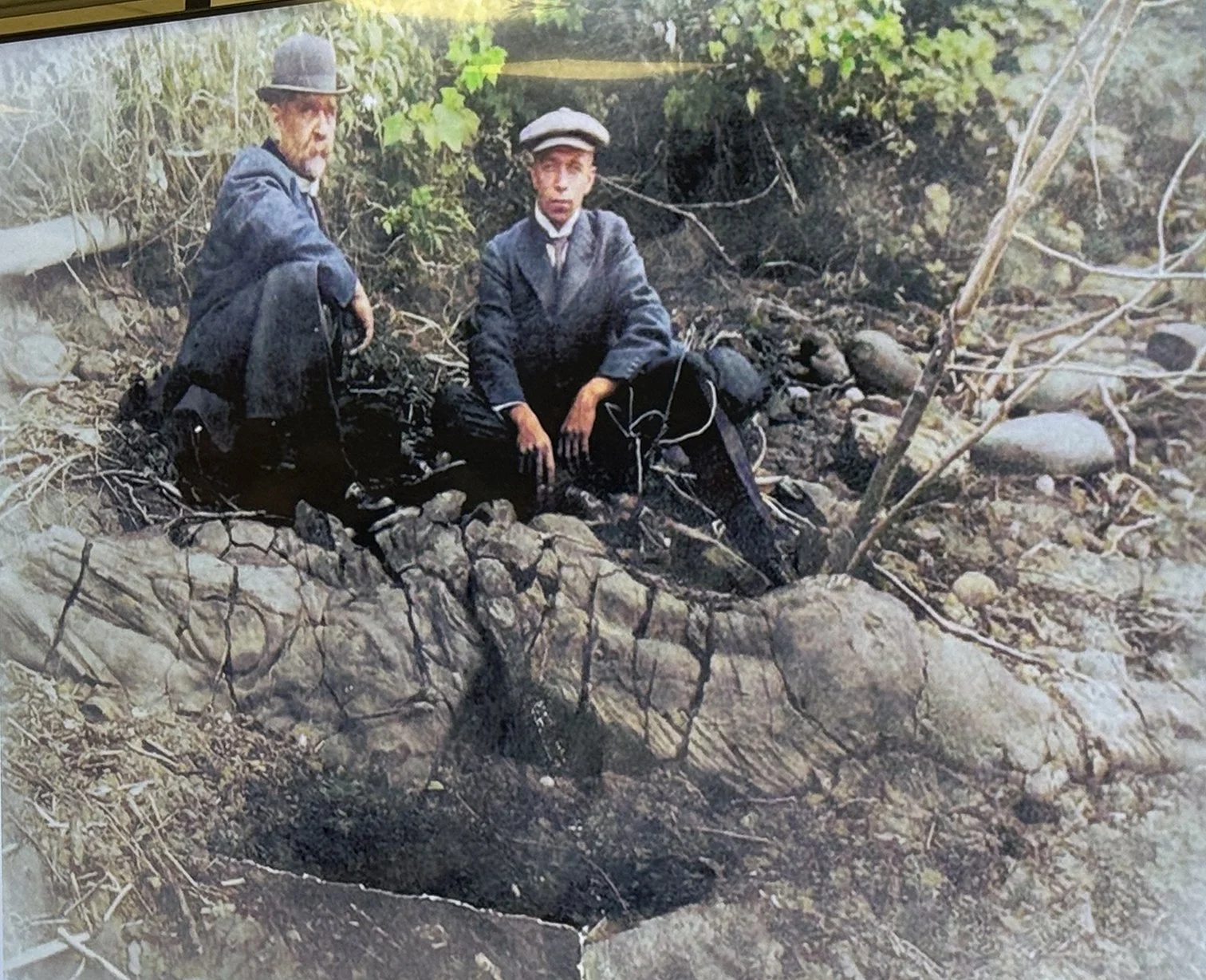
Crowsnest Pass Coal Company officials at discovery site - John Kinnear Photo
My answer was no and he then informed me that there had been no other bone finds in the Rocky Mountains that has ever been recorded so far. And if I was to ever encounter any of this evidence I was to contact him.
Wow! Apparently in the Foothills you can get discoveries like Black Beauty, but not in the Rockies themselves. That was pretty surprising.
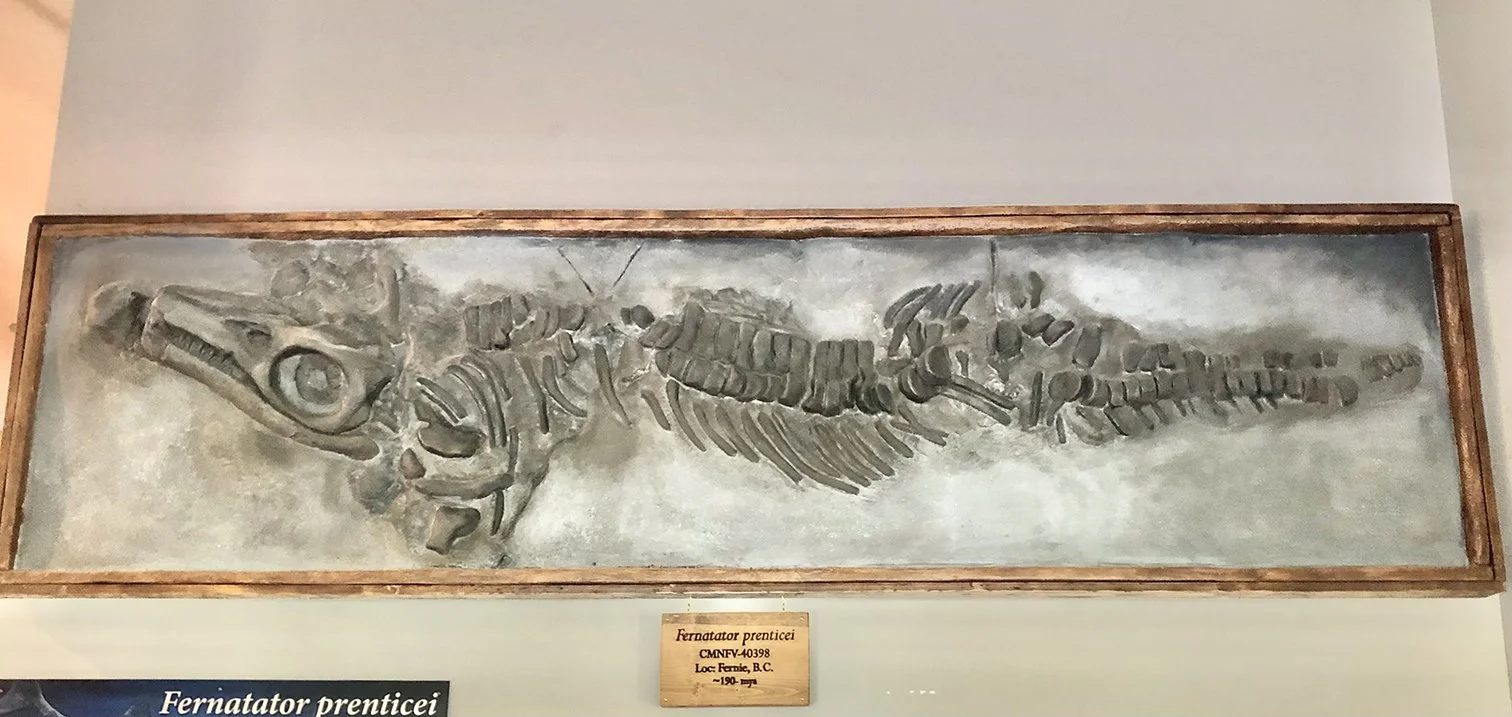
Life size replica of Fernatator Prenticei - John Kinnear Photo
So it wasn’t until last June that the subject of the ichthyosaur discovery came up again. It was while attending the annual Coal Symposium held in Sparwood. A talk was given there by a sedimentary geologist by the name of Bob Morris on that particular ichthyosaur discovery. This specimen, whose name means fish lizard in Greek, was found about 12 kilometres from Fernie on the edge of the Elk River by two officers of the Crows Nest Pass Coal Company on a fishing trip that year. Ichthyosaurs were dolphin-like marine reptiles that ruled the ancient seas from the early Triassic to the beginning of the Late Cretaceous period. The fossilized remains of Prenticei were eventually moved to Ottawa where it sat in a crate at the Museum of Natural Sciences for over 112 years. Eventually it drew the interest of Dr. Judy Massare of the State University of New York, whose expertise is in the evolution, ecology, and biomechanics of Mesozoic marine reptiles. She is considered the leading international expert on ichthyosaurs. She was intrigued by this amazing specimen and conducted an in-depth study on it in 2025 which was eventually published .
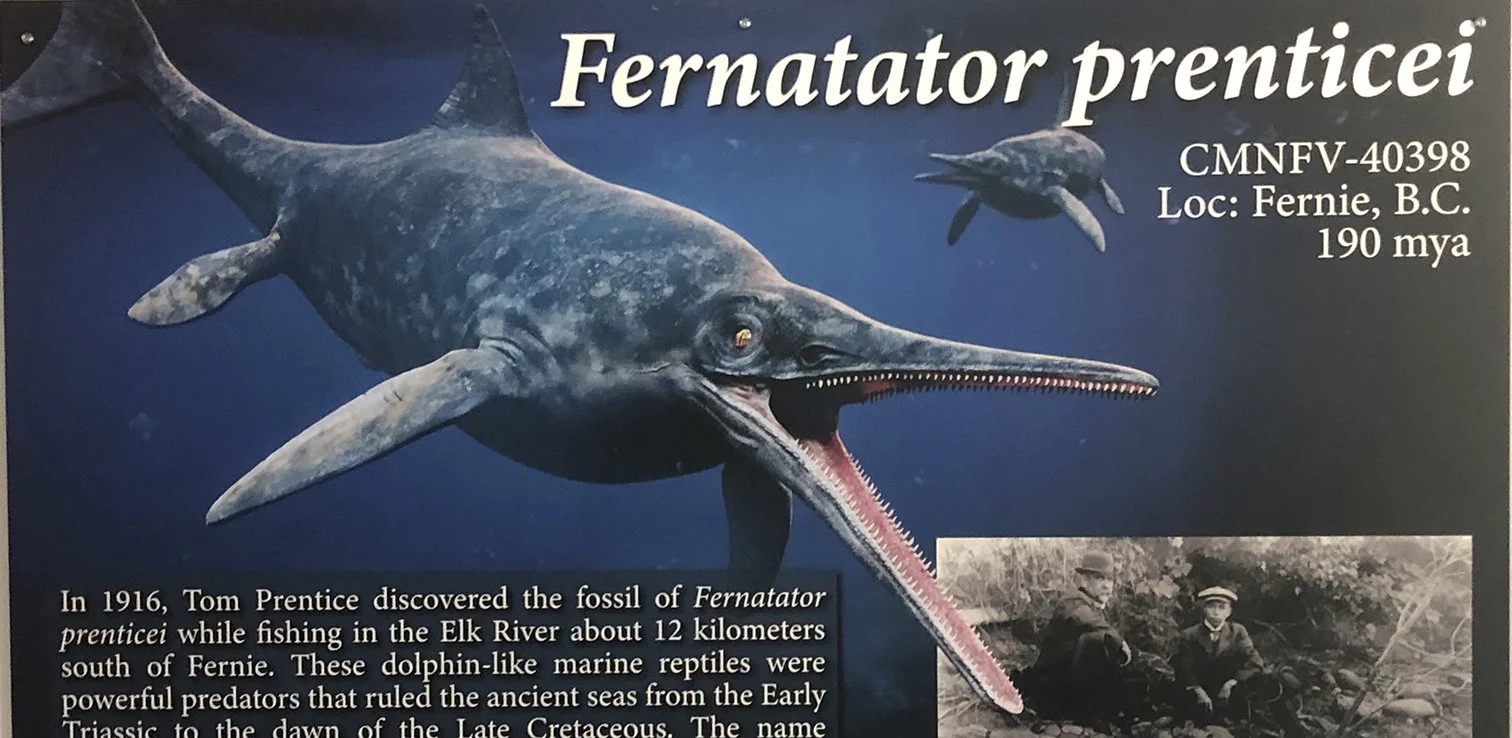
Behold the fish lizard - John Kinnear Photo
Determining Prenticei’s age is an interesting sideline in that it involves Terry Poulton , a scientist with the Geological Survey of Canada and an independent researcher named Murray Edmonds. A bit of detective work by these experts revealed that the small ammonites attached to the fossil skeleton could be dated to between 187 to 190 million years ago. The almost perfectly intact remains of this fish lizard measures almost 3 meters in length. Ichthyosaurs could range from just two feet long to colossal giants like the Shastasaurus or Ichthyotitan which rivaled modern whales. Yup, that sounds titan to me. Just imagine the razor teeth on that guy! Apparently their eyes could be as much as 10 inches in diameter which allowed them to see in deep waters.
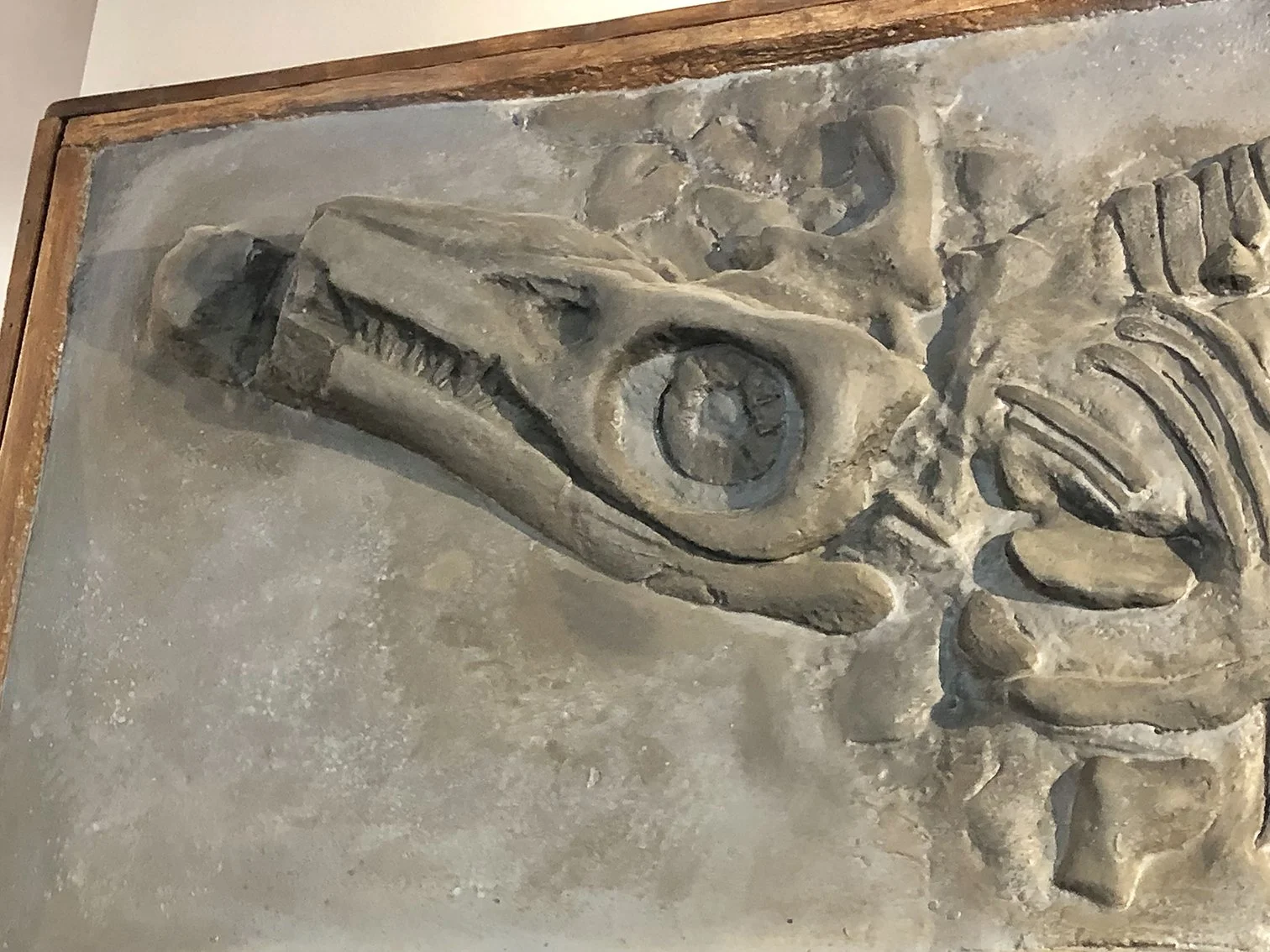
Closeup of head of specimen - John Kinnear Photo
The site where the Morrissey area specimen was found had never been relocated until Bob Morris serendipitously rediscovered in the early 1990’s, ironically also during a fishing trip of his own. Morris eventually co-authored the study with Massare. Bob recognized the distinctive sand bar and scattered concretions from an old newspaper photograph of the discovery site. Crucially, he observed a large, water-filled scar in the ground where the specimen had been removed, confirming the location on the east bank of the Elk River. It is located in the Fernie Group of formations. The black Fernie shale is a common occurrence around here laying directly under the Kootenay (i.e. coal bearing) Formation that all our mines entered.
Speaking of ammonites. You may or may not be aware that there is a giant ammonite to be seen up Coal Creek near Fernie. It was first mapped on a geological survey in 1947 and this truck tire fossil is now regarded as the 12th largest in the world and is dated at around 152 million years old. It is about five feet across and its scientific name is “Titanites occidentalis” There is that word titan again. Two titans of the ancient marine world, both found within a couple kilometres of each other. There is a beautiful replica of “titanites” at the Fernie Chamber of Commerce Tourist Information Center. There is also an amazing replica of Fernatator hanging on the wall. The displays are really worth while dropping in to see.
The ichthyosaur is not considered a dinosaur, which were land based. So technically it still stands that no “dinosaur” remains have been found in the Rockies.
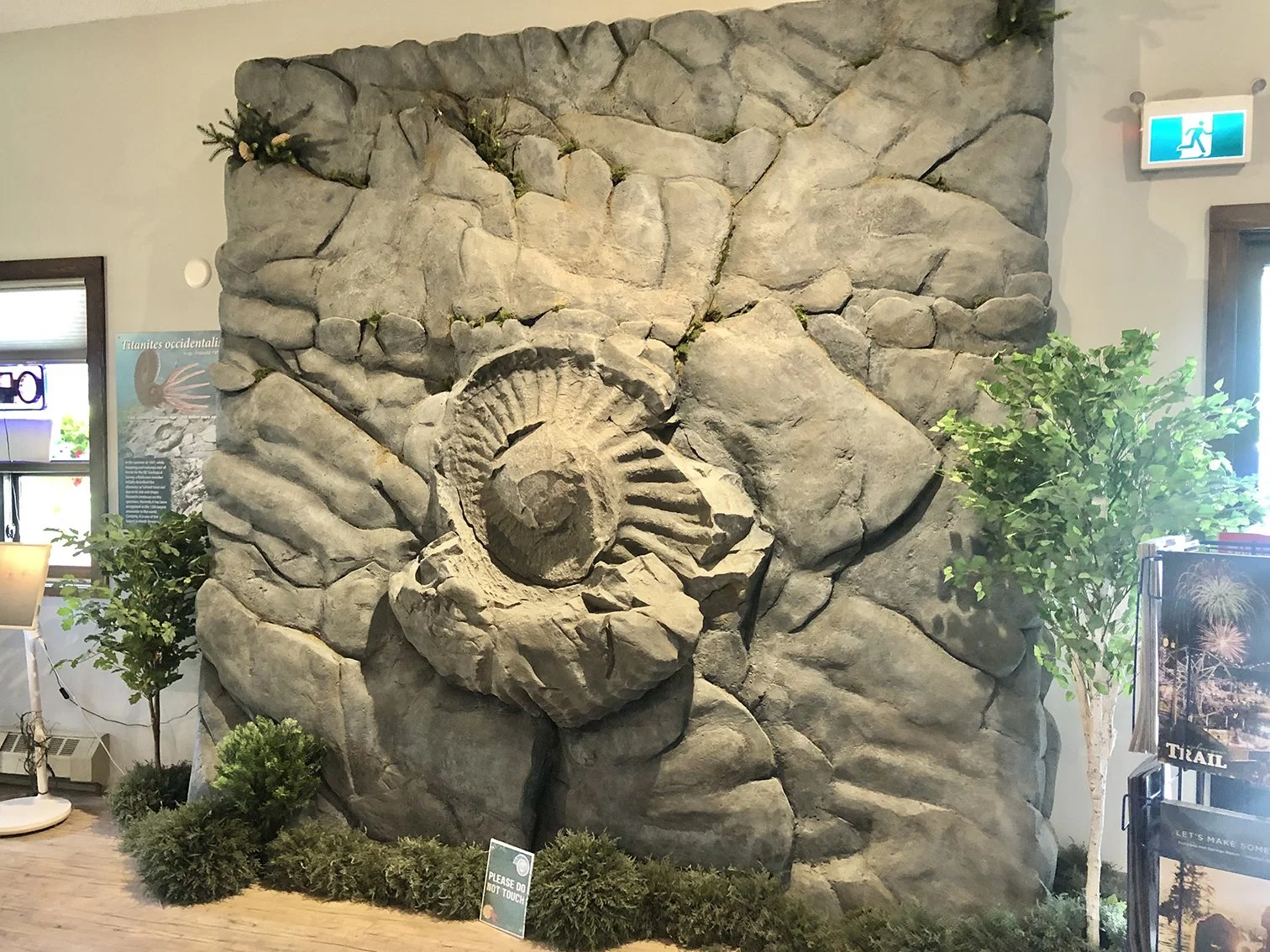
Replica of “titanites” occidentalis - John Kinnear photo
Morris also shared with me a technical paper about another 1970 discovery, of another ancient marine reptile called a plesiosaur. This specimen was discovered in the basal sandstone of the Fernie Group and is “Sinemurian (Liassic, Lower Jurassic) in age”. Whatever! It is in the collection of the Devonian Group of Charitable Foundations in Calgary. According to the paper written by Elizabeth Nichols in 1975 it “is the first member of the suborder Plesiosauria from the Lower Jurassic of this continent, and hence is the oldest plesiosaur from North America.
Plesiosaurs were somewhat different that ichthyosaurs in shape and are described as (get this) looking like a shark pulled through a turtle shell. Wide flat bodies and swam using four flippers. Ichy’s swam using their giant tail fin.
Now get this! This specimen was located “5.4 km east of the Coleman Kananaskis Road, approximately 48 km north of Coleman. The site is on the east bank of an unnamed northern tributary to Ridge Creek and is exposed only at water’s edge. The bones were imbedded in the upper surface of black, massive, conglomeratic sandstone approximately 1 m thick.“ So it appears we have/had an amazing specimen very close to us. That is pretty interesting and while the discovery is pretty rare one has to wonder what else is out there. Perhaps a dinosaur bone or two!