

Councillor court case outlined by taxpayers group
Association says court application targets six-month eligibility rule against Councillor MacDonald
A local taxpayers group used a public meeting to walk residents through Alberta’s municipal election residency rules and a court application that challenges whether newly elected Crowsnest Pass councillor Colleen MacDonald met them.
The Crowsnest Pass Taxpayers Association, a volunteer group led by president Carmen Roman, told attendees the presentation was intended to be educational and not to argue for a specific outcome.
“This evening’s presentation concerns questions that have been raised regarding candidate eligibility in the 2025 municipal election,” Roman said. “It is being presented strictly for educational and informational purposes.”
Roman said Alberta law requires a municipal candidate to have ordinarily resided in the municipality for at least six consecutive months immediately preceding nomination, framing the question as one of statutory compliance rather than motive or character.
“Where questions arise regarding residency, the issue is not one of motive, intent, or character, but rather one of statutory compliance,” she said.
Reached for comment, MacDonald said she had reviewed questions from the Pass Herald but noted the matter is before the courts.
“As you are aware this matter is currently before the Courts and a decision from the Court has not yet been rendered,” MacDonald said.
Roman also said the association raised concerns about eligibility before election day and contacted election officials and provincial authorities seeking clarification and transparency, but said the matter was not resolved prior to the vote.
She said an eligible elector later initiated a legal application under the legislation and the association decided to support it by providing a sworn affidavit and becoming an applicant.
“It is also important to note that the initiation of a legal challenge does not by itself remove a councillor from office,” Roman said, adding that a councillor remains in office unless they resign, council declares a disqualification where authorized by law, or the Court of King’s Bench issues an order declaring a disqualification and vacancy.
Linda Trippel, introduced as the eligible elector advancing the court application, told the meeting the information she shared had been reviewed and approved by legal counsel and was part of the public record.
“I just want to preface the information that I’m going to share this evening has all been viewed and approved by our legal counsel,” Trippel said.
Trippel said the challenge must be brought within six weeks from election day and told attendees she met with legal counsel in October. She said she filed an originating application and swore an affidavit on Nov. 18, followed by what she described as a FIAC hearing three days later where a judge decided the application could proceed.
Trippel said her legal counsel went before a judge on Jan. 13 and requested an expedited hearing, saying the matter was otherwise scheduled to be heard in January 2027.
“So that’s where we’re at legally,” she said.
Trippel told the meeting the originating application originally named MacDonald and the Municipality of Crowsnest Pass as respondents, but said municipal legal counsel and her counsel agreed to remove the municipality because she said there was “no allegation against the municipality at all.”
“So the only respondent currently is Ms. MacDonald,” she said.
Reading from her sworn affidavit, Trippel said she believed MacDonald “was not eligible for nomination nor election as she did not live in the municipality for the six months prior to nomination date or since March 22, 2025.”
Trippel said her affidavit cited observations and online posts she said were inconsistent with residency claims, including statements she attributed to MacDonald in a submission to the Subdivision and Development Appeal Board and multiple social media posts she said referenced the construction and timing of moving into a home in Blairmore.
Trippel also read sections of her affidavit describing communications with municipal election officials before election day and municipal administration after the election. She said she contacted the returning officer on Sept. 21, 2025, with concerns about a candidate’s eligibility.
Trippel said the returning officer told her a candidate is required to swear an oath of eligibility and that if nomination papers are properly completed, the returning officer must accept the person as a candidate.
Roman reinforced that point during the question period when an attendee asked who vets candidates.
“I think what’s critical in that is that each candidate must swear an oath,” Roman said.
Another attendee summarized the process as being accepted “at face value,” prompting Roman to describe the only formal pathway as a court challenge. “Unless someone challenges the oath, which is legal in the Court of King’s bench, then nothing gets done,” Roman said.
Trippel said the consequences of the application were not for the association, election officials or the public meeting to decide.
“We have filed our legal application and the affidavit is what I have sworn my oath to,” she said, explaining that the judge will then determine the outcome based on the evidence provided.
Residents who want to follow the matter can watch for court updates through official filings and are encouraged to seek primary documents before drawing conclusions.
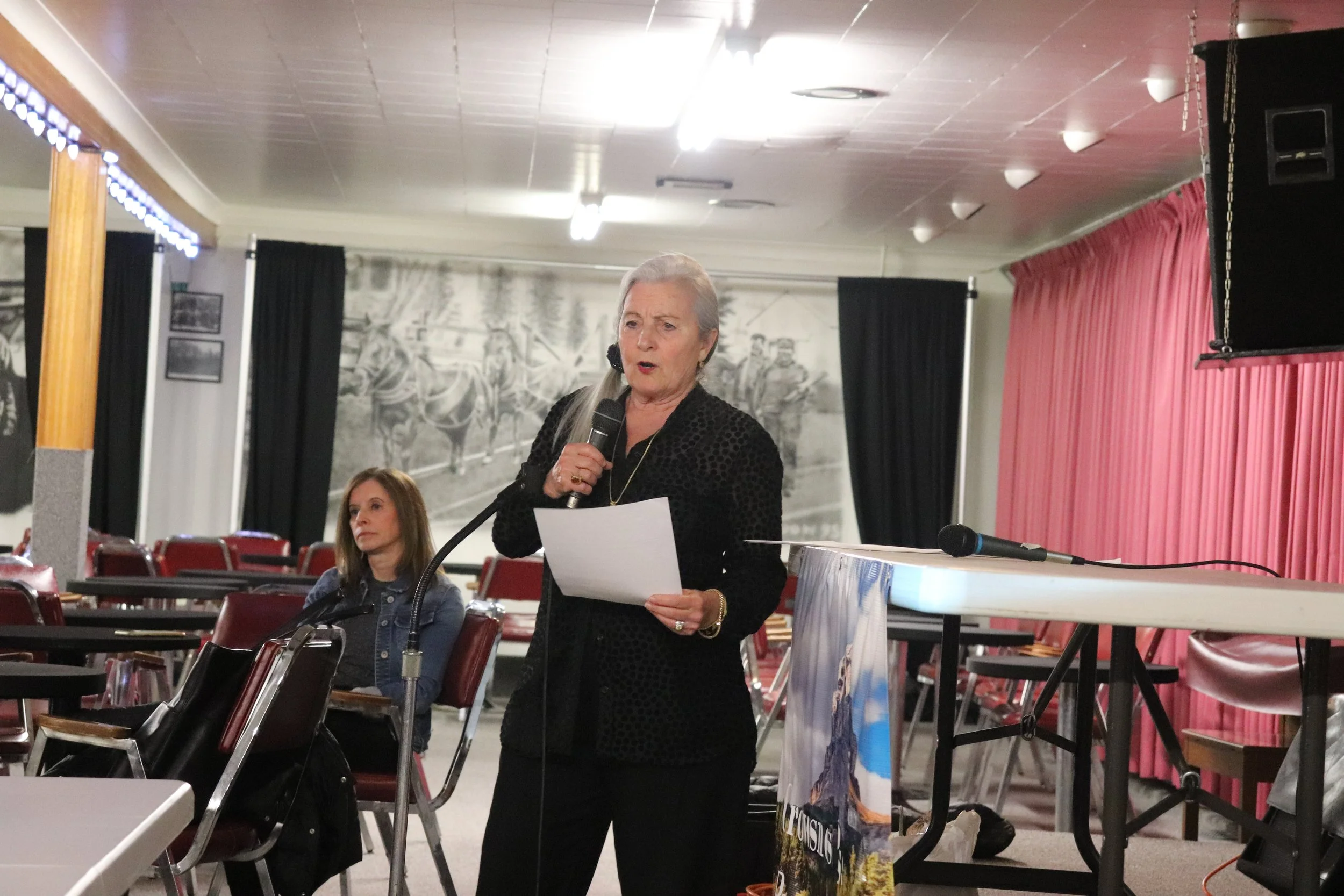
Carmen Roman, president of the Crowsnest Pass Taxpayers Association, speaks during a public meeting in Blairmore where the group outlined Alberta’s municipal election residency requirements and explained a court application challenging whether newly elected Crowsnest Pass councillor Colleen MacDonald met those requirements. Roman said the presentation was intended to be educational and informational. Approximately 15 people, including executive members of the association, attended the meeting. Nicholas L.M. Allen photo