

PTSD advocate shares Sea to Sea story in Coleman
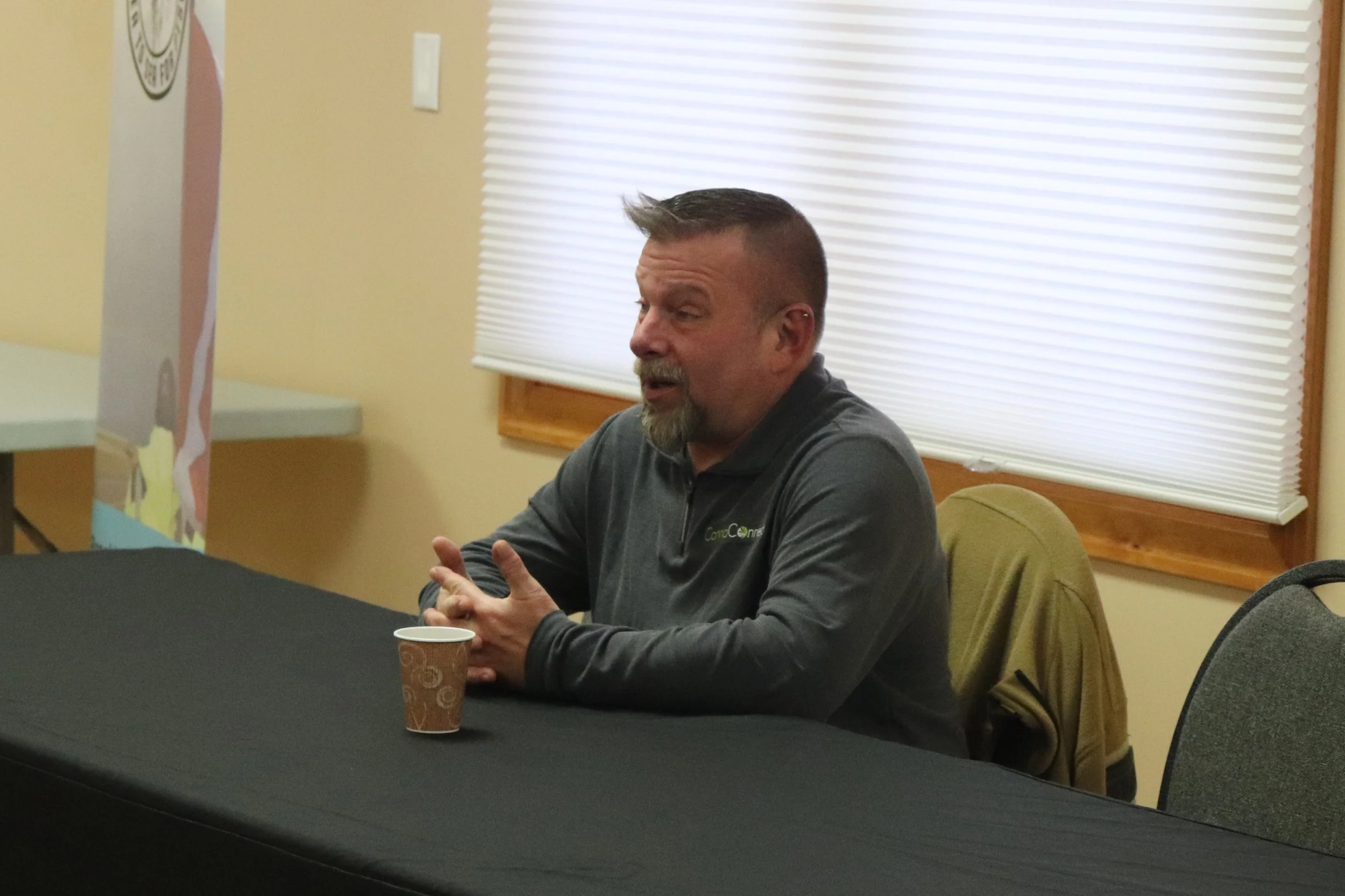
Chad Kennedy speaks about PTSD and recovery at the Coleman Seniors Centre on Jan. 22.
A crowd gathered at the Coleman Seniors Centre on Jan. 22 to hear Chad Kennedy speak about living with post-traumatic stress disorder and the long road that led him to launch the Sea to Sea for PTSD campaign, a project that has included walking across large sections of the country to raise awareness and connect people with mental health supports.
Kennedy opened by telling attendees he had been “having chats right across the country” and said it felt meaningful to share his story at home in the Crowsnest Pass.
In his remarks, Kennedy traced his background through early military service and later work in public safety, describing years spent around trauma that he said accumulated quietly. At one point, he introduced himself as “Jack Kennedy” and referenced his parents, Heather and Gord, who he said played “very, very huge roles” in his healing. He described being born in Banff to a mother who worked as a registered nurse and a father who served with the RCMP.
Kennedy said he joined the Canadian Army in the early 1990s but took a discharge after injuring his legs during training. Years later, he said he began volunteering with a Victim Services Unit in Fort McMurray and then joined the auxiliary RCMP program, experiences he said exposed him to the overlap between addictions, homelessness and mental health.
He said he later worked as a special constable in Fort McMurray and in 2008 moved into the Alberta Sheriff Highway Patrol Program, describing repeated exposure to serious collisions and fatal scenes on highways that he said weighed on him over time. Kennedy said he did not recognize the toll until 2017, when he was winter camping with his father and his father noticed a shift in his personality.
Kennedy said he went to his family doctor, received an emergency psychiatric visit and was diagnosed with post-traumatic stress disorder. He described early experiences with mental health care as harmful and said he came to believe medication would be enough to keep him functioning at work and at home.
Kennedy told the crowd that a turning point came on July 18, 2020, while working south of the Columbia Icefields on Highway 93. He said he and a colleague responded to reports of a bus crash and arrived at what he described as a mass casualty event after an ice bus rolled off the side of the mountain. Kennedy said the first responders on scene faced a lack of tools and support.
“I can tell you; I know there’s tradespeople in here, and if you don’t have the right tools for the trade, [stuff’s] not getting done,” he said.
Kennedy said six law enforcement officers were tasked with triage before fire and emergency medical services arrived, and he described the sense of helplessness he felt while waiting for assistance to reach the scene. He said the longest stretch was waiting for sirens and reinforcements, describing a delay of “an hour and 22 minutes” before fire and EMS arrived from multiple communities.
He said he was ordered to stay overnight in Lake Louise after the chaos settled and described feeling ashamed going out for supper in a dirty uniform. Kennedy told the crowd he does not remember the drive home the next day to get to a place where he felt safe.
In the weeks that followed, Kennedy said he spiralled. He described heavy drinking during a camping vacation and said he struggled to process what happened at the crash site. He said he shut down when people approached him and told him it was “cool” he was there.
“What’s not cool is seeing what I saw, smelled what I smelled, tasted what I tasted, heard what I heard,” he said.
Kennedy said the breaking point came on Aug. 2, 2020, when he described having a meltdown and then drinking alone with suicidal thoughts. He told the crowd he did not follow through, in part because of thoughts of his parents and what it would mean for them.
Out of that night, he said, came a decision that helped keep him alive. Kennedy said he announced he would walk Canada to raise awareness about PTSD, invoking the memory of Terry Fox and Rick Hansen as examples of perseverance and public commitment.
“I’m here to hold myself accountable,” he said.
Kennedy said the first stages of the campaign began in 2022, when washed out highways in British Columbia forced the team to start in Cranbrook rather than Vancouver. He said the group walked along Highway 3 to Medicine Hat before shifting to the Trans-Canada Highway and reaching Montreal in the first year. He said the second year included walking from Quebec City to St. John’s, Newfoundland, except for the ferry crossing.
Kennedy described meeting people in Gander and hearing stories linked to Sept. 11, which he said reinforced his belief the group was not doing enough. He said the walk in 2023 was nearly full length and that the team took 2024 off from the long-distance legs. He said he spent much of that time camping at Island Lake, describing the wilderness as one of his safe places.
He told the Coleman crowd that last summer, 2025, the campaign began the first leg of a second cross country effort, which he said has helped connect the project to more resources. Kennedy said the campaign now focuses not only on awareness but on helping people find support when the act of making calls or navigating online information feels overwhelming.
“If you need resources, please contact me,” he said. “I might not be able to find you the exact resource, but I [have] somebody that can find you the right fit.”
During a question period, Kennedy was asked what therapies and activities have helped him process trauma. He said he does not believe he will ever fully get past PTSD but said he has learned ways to live with it. Kennedy said walking outdoors became a key form of therapy, and he described turning off music to better listen to his body and surroundings. He also mentioned tapping therapy, drum therapy and returning to hobbies such as wood burning and building small projects as a form of meditation and focus.
Another attendee asked about triggers and what sends him into dark periods. Kennedy said triggers can “sneak up on you” and described being set off by the sound of a collision, by feelings of helplessness and by certain smells. He said diesel fumes in cold weather can be a trigger, as can what he described as the smell of iron. Kennedy also described avoiding crowded spaces like Costco and said he prefers to sit with his back to a wall until he feels safe.
Questions also touched on emerging approaches such as MDMA assisted therapy and other psychedelic based treatments. Kennedy said he has spoken with people about such options but described Canada as restrictive and described a system he believes moves slowly due to regulation and oversight. He compared those barriers to how cannabis eventually became accessible and said he has seen meaningful change when treatments become available through Veterans Affairs.
The conversation also turned to affordability. Kennedy described private psychological appointments as expensive and said many people do not have benefits that cover the amount of care they need. He said peer support programs can help bridge gaps, but argued public systems are not doing enough to make timely mental health care accessible through the health system.
Kennedy also raised concerns about government funding and accountability, telling the room he has asked questions about mental health dollars and believes clearer answers are needed about where money goes and what it delivers.
Looking ahead, Kennedy said the campaign will resume this spring, including plans to return to Montreal on May 16 and complete a short walk through Vermont and New York State before restarting in Canada. He said the next Canadian leg is expected to begin June 1 in Sarnia, Ont., and run west toward Vancouver Island, with the team hoping to organize a community walk in the Crowsnest Pass when they come through later in the summer.
Kennedy encouraged residents to keep talking about mental health at home, at work and with younger generations, and he reiterated his invitation for anyone needing help to contact him directly or connect through local and regional supports.