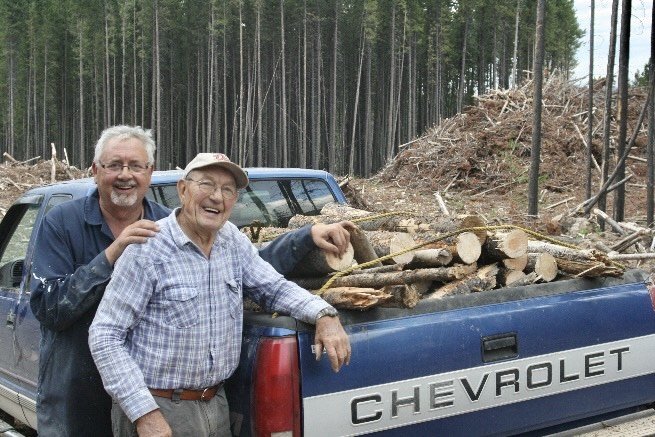
The history of the Juhlin family in the Crowsnest Pass has been diligently compiled by Tim Juhlin, grandson of this families’ roots here. The story, he has noted, extends back to Sweden where Magnus Albin Juhlin was born in Norrtalje, a small town about 70 km north of Stockhlom, the capital of Sweden. In 1928, at the age of 17, Magnus immigrated to Canada and somehow ended up buying a small lignite coal mine west of Minton, Saskatchewan knows as the Roan Mine.
In 1935, during what they called the “dirty thirties, he set off, with his wife Grace, daughter Alice and son Arthur, for British Columbia. At that time the Alberta/BC provincial border was manned with a check stop that screened those entering BC. To continue on they had to buy a BC drivers license and also prove that they had enough money to live.
The family only had $14, which was not enough, so they were turned back at the border. Returning back past Crowsnest Lake Magnus broke into and settled the family in one of Morency’s cabins near the old dance hall. This was how Magnus, Grace, and family first began living in the Crowsnest Pass. They had planned to stay just long enough to acquire some cash and then be on their way into B.C., but they never ever did continue the journey west.
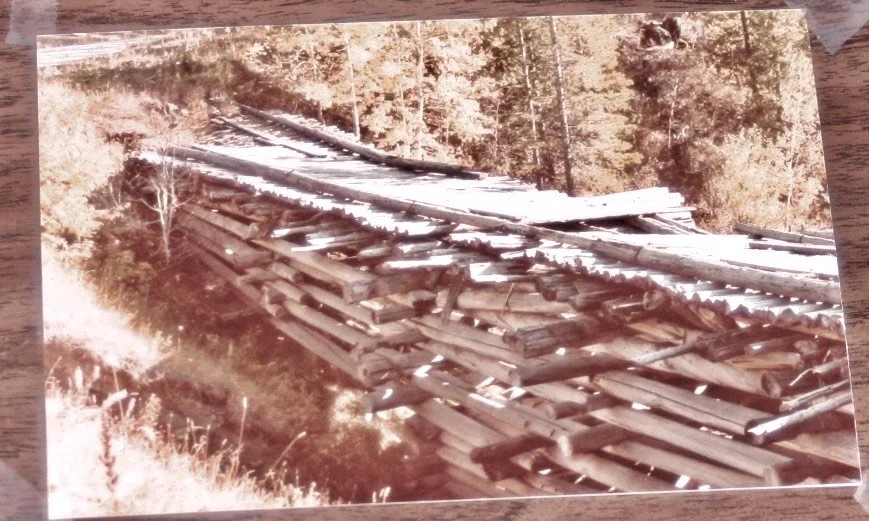
Tim was somewhat aware of some of the family history but it was in a visit to friends place in Lethbridge years ago, where an old photo in an album, taken by amateur photographer back in the 60’s, surfaced that inspired him to go deeper. The photo was of a trestle that was constructed on the Atlas road that Tim remembered seeing the remains of, on about km. 3.2 on the infamous Atlas road north and west of Coleman.
This historic photo prompted him to interview his father Arthur (Art) regarding the history of forestry and road development near Crowsnest Mountain. Together with his father’s stories and snippets of what he knew of his family history he put together the following.
Tim said that, “In studying the Rocky Mountain Repeat photographs for the Crowsnest Valley, it seems that there were a number of forest fires in the early 1900’s.” This information incidentally comes from the Mountain Legacy Project, which uses historic and modern air photos taken of the same area to study changes. One of the most damaging fires in the area was in 1910 and effectively shut down the McLaren Lumber Company, forcing Peter McLaren to sell his Alberta holdings.
This fire provided an opportunity some twenty years later, for selection and logging of preferred props for underground mining. A timber used to support rock or coal underground is referred to as a “prop”. Preferred props had to be dry seasoned wood because when they would begin to fail underground, under the pressure of the mine roof or held coal, a sharp crack or snap would signal its failure and give warning. A green prop, on the other hand, would hold its weight and just eventually fail completely, without giving warning to the underground miners.
Since there were large tracts of old, standing, dead lodgepole pine, located at the base of Crowsnest Mountain, there was an incentive to harvest them as props. Magnus got a job working for contractor Elidio Salvador cutting props. Magnus, Grace, Alice and Art (who was about 5 yrs old) moved up onto the slopes on the south side of Crowsnest Mountain where they lived in a tent by a creek for two years including the winter seasons. Art remembers Magnus lifting the tent roof up with his back to topple the snow off that had accumulated overnight. It’s hard to imagine today moving up onto the side of a mountain to camp and cut props.
Tim recalls that at 16 years of age he had shot a cow elk on the side of Crowsnest Mountain and had to leave it up there for two nights before retrieving it. It seems that when Magnus, Art, Tim and his brother Keith went up to pull that elk out Magnus seemed to know the trails well and pointed out little collapsed trestles and rotted logs along the way. The logs were located where some props were piled in preparation for rolling onto a small flat deck truck.
Magnus shared then that his wife Grace had felled 128 trees in one day using just a Swede saw. Magnus would have then had to buck and limb those trees, which would mean that he likely made three times 128 cuts during the day. Then, of course, they had the task of moving of the logs to the deck locations which was a tough job by any means. Magnus also pointed out, while they were on that elk retrieval, the location where they tented next to a creek and where they stored the butter during the summer, under a waterfall where it could be kept cold.
Since the prop harvest was some twenty years after the fire, it destroyed some of the après fire regeneration on the harvest trails. Some of those skid trails, used at that time, can be seen when viewing the timber just below the rock line of Crowsnest Mountain.
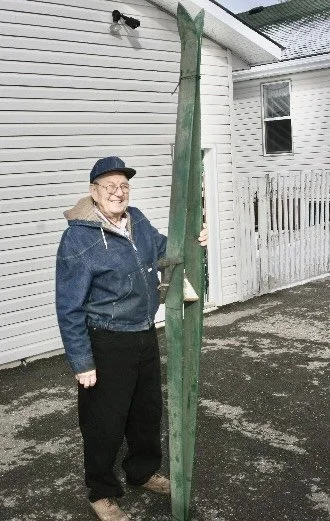
A fascinating point that Art shared was that Magnus and Grace would ski from Crowsnest Mountain down to Bobbit’s store (later Salus’s) in West Coleman for supplies and then return in the same day. This would have been a considerable endurance workout! Magnus built their own skis and Art still has Magnus’ skis in his garage. Tim was excited to see those homemade skis that carried them back and forth in such an unimaginable trip. Magnus was only about 5’2” tall and in the picture shown is Tim’s dad Art, now only 5’8”, with those very same skis.
They measure 8’1/2” ft. long and each has a width of 4 inches. Magnus explained to his grandson that they would find a dead tree with the right root curvature and use that to help form the tip of the ski. These particular skis shown were constructed while camping on the side of Crowsnest mountains pre 1940 and are an invaluable part of the Juhlin story.
Arthur stated that the trestle in the picture was built by Magnus and Frans Nelson (often just called Nels) who were both working for Salvador. They only had axes, crosscut and swede saws then and must have used horses and pulleys and brute strength to move the logs into position.
On the matter of the logging roads built near the Crow, the story goes that two main loggers were in the area. Together they made the decision that Sam Sagoff would build roads and log to the west into Deadman’s Pass, and that Elidio Salvador would build roads and log to the north, constructing the first trails on the west side of Crowsnest Mountain and the Seven Sisters up to the height of land. Later on the road was extended into the Racehorse Pass area. What we know today as the Atlas road did not exist then and Tim says it is possible today, if you know what you are looking for, to see the old roadbed grades along the existing road.
Tim’s dad did not get to see the trails being built but was sure they were constructed using a fresno (a scoop with handles) and horses. He remembers the fresno in his granddad’s yard when he was young. It was also used with horses borrowed from Salvador to dig out the basement of Magnus’s house located in the Willow Drive area of West Coleman. Magnus also set up a mill right in the yard to cut the rough lumber for building houses in Willow Drive
Art Juhlin recalled that, a few years after the road up to Racehorse Pass was in place, he used to fill his pockets with rocks and climb up on the top of the loaded prop truck. The rocks were used to cork grouse along the trail as they hauled the load. So can you imagine a young eight-year-old, on the top of a log load, throwing rocks? That’s just crazy!
There is so much more to this family story and Magnus’s son Art’s own personal journey and memories to be shared. Just a small piece of this family’s history where we are once again connecting the dots.
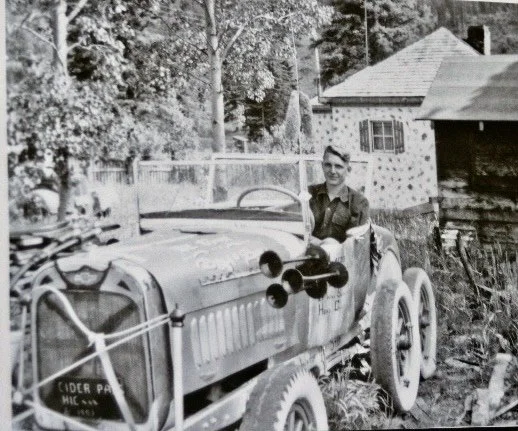
Author’s Note: Magnus was an innovator and self sufficient man who on more than one occasion adapted Model T generators to windmills to generate power. And of course he made the blades for the windmills. One of his most memorable creations was to modify a 1924 Chevy Coupe for the 1951 rodeo parade in downtown Coleman. He added a fake third axle to the coupe, which provided for a lot of puzzled parade watcher’s reactions. To see this modified Chevy in action, along with a fabulous compilation of amazing video footage of the early years of the renowned Coleman rodeo, you can purchase a DVD copy of it at the museum.